
Round Lenses are no longer limited to one nostalgic frame shape. They now serve different visual, practical, and aesthetic needs. A clear prescription lens may support everyday vision. A polarized lens can reduce harsh reflections from roads, windows, and water. Photochromic lenses darken outdoors, while blue-light filtering options appeal to people who spend long hours before screens. Tinted lenses add character, but their optical value depends on the tint, coating, and intended environment.
Dr. Lyndon Jones, a respected contact lens researcher, has stated, “Contact lenses are medical devices, and they need to be treated as such.” His point matters here. Even attractive Round Lenses require careful selection, accurate prescriptions, and professional fitting when they are used for vision correction. Comfort should not be treated as a minor detail. A lens that looks perfect in a shop may feel heavy after six hours at a desk or distort vision while driving at dusk.
This guide examines the top types of Round Lenses through materials, coatings, optical performance, and daily use. It considers prescription lenses, sunglasses, photochromic designs, polarized options, and specialty choices. Some categories overlap. That is where comparisons become imperfect. Marketing language can also sound more scientific than it really is. Readers should check measurements, coating quality, UV protection, and eye-care advice before choosing.
Style matters. Vision matters more.
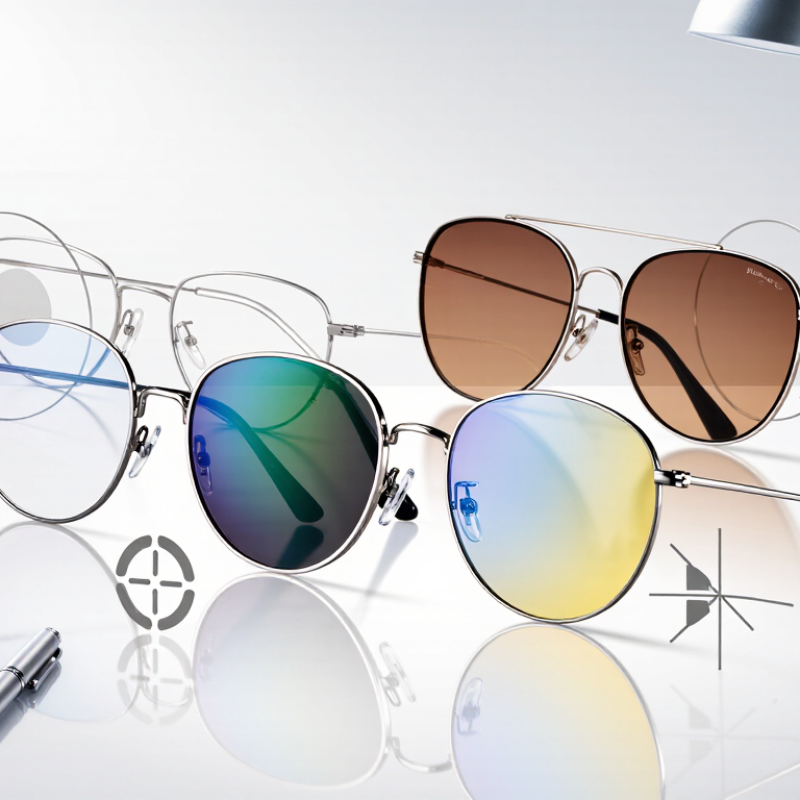
A round lens has a circular or nearly circular visible outline. Its defining feature is shape, not optical power. The curve may be spherical, aspherical, or customized for prescription needs. This distinction matters. A round frame can hold single-vision, bifocal, or progressive lenses.
Optical professionals usually classify round lenses in several ways. Shape classification includes true circular, oval, and softly rounded designs. Optical classification covers single-vision, multifocal, and progressive correction. Material classification includes mineral glass, standard plastic, polycarbonate, and high-index plastics. ISO 13666 provides recognized vocabulary for ophthalmic optics, while ISO 8980 addresses finished spectacle lens performance. These standards support clearer specifications, but real products can still vary between laboratories.
The World Health Organization’s World Report on Vision estimates that at least 2.2 billion people have vision impairment worldwide. That figure shows why classification should not rely on appearance alone. A round lens may look simple, yet its center thickness, edge profile, optical center, and fitting height affect comfort. Measurements must match the wearer’s prescription and frame geometry. The boundary is not perfectly fixed.
Tips: Check the lens diameter, bridge distance, and optical center before ordering. Ask whether the lens is spherical or aspherical. For strong prescriptions, thinner materials may improve appearance and reduce edge weight. However, material choice can change clarity, impact resistance, and cost. A wider round lens is not always better. Styling sometimes wins, but vision should lead.

Round lenses are optical elements with curved surfaces, and their shape influences how light travels. A convex round lens bulges outward, like the center of a small glass pebble. It brings parallel rays toward a focal point. This is convergence. Convex lenses appear in reading glasses, magnifiers, cameras, and laboratory instruments. Their focal length depends on curvature, material, and thickness, not diameter alone. A stronger curve usually creates a shorter focal length. That rule needs care. Thick lenses and spherical surfaces can introduce aberrations, so images may soften near the edges. In practical testing, technicians often use a distant target and measure the sharpest projected image.
A concave round lens curves inward at the center. It spreads parallel rays outward, creating a virtual focal point on the incoming-light side. This is divergence. When viewed through it, nearby objects may look smaller. Concave lenses help correct nearsightedness and reshape light beams in optical systems. The difference seems simple, but real performance depends on spacing, wavelength, and surface accuracy. A lens can combine convex and concave surfaces. That is why terms such as biconvex, plano-convex, biconcave, and plano-concave matter. A basic ray sketch is useful, yet it can mislead with thick lenses. I would recheck measurements under actual lighting. Small alignment errors can change the apparent focal point. Not always.
Round optical lenses are used to control light in ways that simple flat windows cannot. Their circular shape supports even light distribution and predictable image formation. Plano-convex lenses focus parallel rays toward a point. Biconvex lenses provide stronger convergence for compact imaging systems. Concave lenses spread light outward. Each profile serves a different optical purpose.
The main use of circular optical lenses is imaging. Cameras, inspection instruments, microscopes, and scientific sensors use them to form sharper images. Designers also place these lenses in beam expanders, projectors, and measuring devices. A lens can enlarge a small feature, redirect a beam, or improve the usable field of view. In lighting equipment, molded circular lenses shape narrow beams or soften harsh illumination. The result depends on curvature, material, surface quality, and spacing.
Not every round lens creates a clear image. That distinction matters. Aberrations can produce blurred edges, color fringes, or uneven focus. In practical testing, even a small tilt may shift the image noticeably. Engineers often combine positive and negative lenses to reduce these errors. Anti-reflective coatings can improve transmission, but they are not a cure for poor alignment. Selecting a lens by diameter alone is tempting, yet incomplete. The required focal length, wavelength range, aperture, and working distance should guide the choice. Some applications need a simple spherical lens. Others require an aspheric or achromatic design. The “best” lens depends on the optical task, not its appearance.
| Lens Type | Optical Category | Surface Profile | Main Optical Function | Common Applications | Key Consideration |
|---|---|---|---|---|---|
| Plano-Convex Lens | Positive Lens | One flat surface and one outward-curved spherical surface. | Converges approximately parallel incoming rays toward a focal point. | Beam focusing, optical instruments, imaging systems, projection assemblies, and laboratory experiments. | Works best when light enters the curved surface and the lens is used with relatively low spherical aberration requirements. |
| Bi-Convex Lens | Positive Lens | Two outward-curved spherical surfaces. | Converges light and can form real or magnified images, depending on object distance. | Magnifiers, cameras, telescopic assemblies, microscopes, optical sensors, and imaging prototypes. | Often selected for symmetrical layouts; its performance depends on curvature, diameter, thickness, and refractive index. |
| Positive Meniscus Lens | Positive Lens | One convex surface and one weaker concave surface, producing a net positive power. | Converges light while potentially reducing some aberrations in a multi-element optical system. | Compact imaging modules, eyepieces, beam-expanding systems, and optical relay assemblies. | The orientation and surrounding lenses strongly affect aberration correction and image quality. |
| Plano-Concave Lens | Negative Lens | One flat surface and one inward-curved spherical surface. | Diverges approximately parallel incoming rays as if they originated from a virtual focal point. | Beam expansion, optical alignment, focal-length adjustment, and correction of converging optical paths. | Usually used with other lenses because it does not form a real focus from a collimated beam by itself. |
| Bi-Concave Lens | Negative Lens | Two inward-curved spherical surfaces. | Diverges light and provides negative optical power. | Beam spreading, image-scale reduction, optical correction, and compact vision systems. | Useful for correcting excessive convergence, but edge thickness and aberrations should be considered in high-power designs. |
| Negative Meniscus Lens | Negative Lens | One concave surface and one weaker convex surface, producing a net negative power. | Diverges light while offering a compact way to modify optical power and control aberrations. | Camera objectives, optical correction groups, beam-control assemblies, and imaging relays. | Frequently paired with positive lenses to adjust focal length and improve overall optical performance. |
| Cylindrical Lens | Astigmatic Lens | Curved in one direction and flat in the perpendicular direction. | Focuses or spreads light along one axis rather than producing a point focus. | Laser line generation, machine vision, barcode scanning, optical measurement, and laser projection. | Correct alignment is essential because its optical power is directional and axis-dependent. |
| Aspheric Round Lens | Specialty Lens | At least one surface has a non-spherical profile that changes gradually with radius. | Controls spherical aberration more effectively than a simple spherical lens in many designs. | Compact cameras, laser collimators, optical sensors, illumination systems, and imaging modules. | Can provide improved performance with fewer elements, but manufacturing, testing, and alignment may be more demanding. |
| Achromatic Doublet | Compound Lens | Two cemented or closely spaced lens elements made from glasses with different dispersion characteristics. | Reduces chromatic aberration across two selected wavelength regions while also providing positive or negative power. | Telescopes, microscopes, spectrometers, cameras, and general-purpose imaging instruments. | Corrects color more effectively than a single simple lens, but the correction is not uniform across every wavelength. |
| Fresnel Lens | Stepped Positive Lens | Concentric annular sections approximate the shape of a conventional curved lens. | Produces convergence with substantially reduced material thickness and mass. | Solar concentrators, overhead projectors, lighthouse optics, motion sensors, and large-area illumination systems. | Lightweight and economical for large apertures, but groove structure can increase scattering and reduce image quality. |
Round lenses are often grouped by how their surfaces bend light: spherical or aspherical. A spherical round lens uses one consistent curve across its surface. This shape is easier to manufacture and usually costs less. However, light rays entering near the edge may focus differently from central rays. The result can be softness, halos, or reduced contrast.
Aspherical round lenses use a changing curve from the center toward the rim. This design controls spherical aberration more effectively, especially at wider apertures. Fine text may look sharper near the edges. A compact camera module may also become thinner because the lens can correct optical errors with fewer elements. In practical evaluation, I would inspect a grid, bright point, and high-contrast lettering. These details reveal edge distortion better than a casual indoor view.
Still, aspherical does not automatically mean better. Poor polishing or inaccurate alignment can create uneven sharpness, flare, or visible “onion-ring” patterns. Spherical lenses may provide smoother rendering and predictable performance in simpler optical systems. They can also be easier to replace or adjust during prototyping. The best choice depends on aperture, field of view, thickness, and production tolerance. That distinction is easy to miss. A lens that looks excellent in the center may disappoint at the rim. Careful testing under real lighting remains necessary, because specifications alone cannot describe every viewing experience.
Round lenses are commonly designed as spherical or aspherical elements. Spherical lenses use constant-radius surfaces, while aspherical lenses vary in curvature to improve optical correction and support thinner designs.
Round lenses are defined by their shape, not their optical function. Common choices include single-vision, progressive, photochromic, and high-index lenses. Each serves a different visual need.
Prescription accuracy comes first. The World Health Organization’s World Report on Vision estimates that at least 2.2 billion people have near or distance vision impairment worldwide. A round frame cannot correct an unsuitable prescription. Ask an optician to check pupillary distance, optical centers, and fitting height. Small errors may create blur, eye strain, or unwanted distortion.
Frame diameter matters too. Larger round lenses usually provide a wider field of view, but they can add weight and increase edge thickness. High-index or aspheric designs may improve appearance for stronger prescriptions. Yet thinner is not always better. Material strength, impact resistance, and daily use still matter. For active users, impact-resistant materials deserve attention.
Coatings should match the environment. Anti-reflective treatment can reduce reflections during nighttime driving or office work. Photochromic lenses can help outdoors, while polarized lenses reduce surface glare. They may not suit every dashboard display or workplace screen. The Vision Council’s 2023 Consumer inSights report indicates that roughly three-quarters of adults use some form of vision correction. Preferences are therefore broad, not universal.
I would not choose round lenses by appearance alone. A stylish frame can sit poorly, slip downward, or place the optical center incorrectly. Lens thickness, bridge fit, prescription strength, and lifestyle should be assessed together. Standards such as ISO 8980-1 also support checking lens optical quality and performance.