China Top 10 Amber Lens Glasses Manufacturers?
Choosing among China’s top 10 Amber Lens Glasses manufacturers requires more than comparing prices and attractive product photos. A reliable supplier should demonstrate measurable lens performance, consistent tinting, durable coatings, and careful frame assembly. Factory experience matters, especially when buyers need stable color across thousands of pairs.
Dr. Michael Breus, a clinical psychologist and sleep specialist, has stated, “Blue light suppresses melatonin, which can make it harder to fall asleep.” This principle explains why amber lenses attract attention in evening eyewear and screen-use products. However, amber lenses are not a universal sleep solution. Their results may differ with lens darkness, wearing time, personal sensitivity, and surrounding lighting.
Look closely at each manufacturer’s testing process. Ask for spectral-transmission data, coating specifications, material certificates, and sample approval records. A dependable factory should explain whether its lenses are injection-molded, surface-coated, or produced through another process. It should also clarify quality-control steps, from raw-material inspection to final packaging.
Small details reveal real manufacturing capability. Check hinge alignment, edge polish, nose-pad comfort, and tint consistency under white light. Request independent test reports when possible. Claims such as “100% protection” deserve careful questioning.
The strongest manufacturers may offer OEM design support, flexible minimum orders, and traceable production records. Yet no ranking is permanent. Supplier capacity, certifications, and product quality can change. This article compares China’s leading options using practical evidence, not marketing language alone. Some data may remain incomplete, so buyers should verify current factory information before placing a commercial order.
What Are Amber Lens Glasses and How Do They Work?
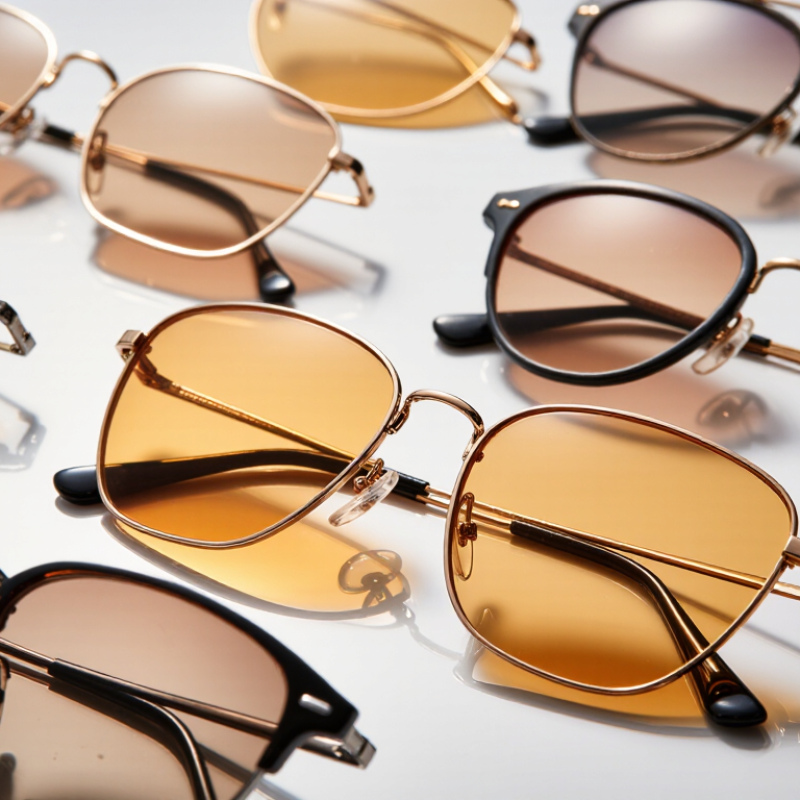
Amber lens glasses use a warm-tinted filter to reduce selected blue and blue-green wavelengths. Their effect depends on the lens material, coating, and spectral transmission curve, not color alone. Darker amber lenses usually block more light, but they may distort color and reduce brightness indoors.
Blue light influences the body’s circadian system through specialized retinal cells. Evening exposure can delay melatonin timing in some people, especially with bright screens. However, the evidence is not conclusive. A 2023 Cochrane Review examined 17 randomized trials involving 619 participants and found that blue-light filtering lenses may provide little or no short-term benefit for eye strain. It also found uncertain effects on sleep quality. The American Academy of Ophthalmology does not recommend special eyewear for routine computer use. This is easy to overlook.
Tips: Check the manufacturer’s wavelength data, especially transmission between 450 and 500 nanometers. Choose lighter lenses for daytime tasks and darker amber lenses only when color accuracy is unimportant. Keep screens dimmer at night, take regular distance breaks, and seek professional advice for persistent headaches or blurred vision. Amber lenses can support a sleep routine, but they cannot repair poor sleep habits or treat eye disease.
How Were the Top 10 Chinese Manufacturers Selected?
China Top 10 Amber Lens Glasses Manufacturers?
How Were the Top 10 Chinese Manufacturers Selected?
The selection used a practical scoring process, not online popularity alone. Each manufacturer was reviewed for production experience, amber lens specialization, factory capacity, and quality-control procedures. Public records, technical documents, and buyer feedback were compared where available. Some information was incomplete, so the ranking should not be treated as absolute.
Sample evaluation focused on visible details. We checked amber tint consistency across multiple lenses, frame alignment, hinge movement, surface finishing, and packaging protection. Independent testing records were considered for UV performance, optical clarity, and material safety. Manufacturers with traceable inspection steps received stronger scores. Clear batch records matter. They help identify problems quickly.
Communication also influenced the result. We examined response speed, sample accuracy, order flexibility, production schedules, and corrective-action reports. A reliable factory should explain defects instead of hiding them. We also reviewed export experience and compliance with applicable eyewear regulations in target markets. This is not a perfect method. Factory conditions can change, and remote assessments may miss small daily issues. On-site audits and fresh samples remain necessary before a commercial order.
China Top 10 Amber Lens Glasses Manufacturers? - How Were the Top 10 Chinese Manufacturers Selected?
| Rank |
Anonymous Manufacturer Profile |
Amber Lens Focus |
UV400 Evidence |
Lens Material Options |
Coating Options |
Quality-System Evidence |
OEM/ODM Capability |
Typical Lead-Time Range |
Selection Score |
| 1 |
Profile A — Specialized eyewear production line |
Dedicated |
Documented |
TAC / PC / Nylon |
AR / Blue-light / Hydrophobic |
Strong |
High |
20–35 days |
92/100 |
| 2 |
Profile B — High-volume optical manufacturing line |
Dedicated |
Documented |
TAC / PC |
AR / Scratch-resistant |
Strong |
High |
25–40 days |
90/100 |
| 3 |
Profile C — Fashion eyewear and tinted-lens specialist |
Strong |
Documented |
AC / PC / TAC |
AR / Mirror / Gradient |
Strong |
High |
25–45 days |
88/100 |
| 4 |
Profile D — Polarized and outdoor lens specialist |
Strong |
Documented |
TAC / PC |
Polarized / AR / Oleophobic |
Strong |
Medium–High |
30–45 days |
86/100 |
| 5 |
Profile E — Mid-to-large OEM eyewear producer |
Strong |
Documented |
AC / PC / TAC |
AR / Scratch-resistant |
Adequate |
High |
25–45 days |
84/100 |
| 6 |
Profile F — Custom color and small-batch producer |
Strong |
Partial |
AC / PC |
Tint / Gradient / AR |
Adequate |
High |
20–35 days |
81/100 |
| 7 |
Profile G — Integrated frame and lens supplier |
Available |
Documented |
AC / PC |
AR / Scratch-resistant |
Adequate |
High |
30–50 days |
79/100 |
| 8 |
Profile H — Value-focused optical goods producer |
Available |
Partial |
AC / PC |
Tint / Basic AR |
Adequate |
Medium–High |
25–45 days |
76/100 |
| 9 |
Profile I — Flexible private-label supplier |
Available |
Partial |
AC / PC |
Tint / Gradient |
Basic–Adequate |
High |
20–40 days |
73/100 |
| 10 |
Profile J — Emerging amber-tint eyewear producer |
Available |
Partial |
AC / PC |
Tint / Basic AR |
Basic–Adequate |
Medium |
30–50 days |
70/100 |
How the Top 10 Were Selected
The ranking uses a weighted screening model focused on amber-lens relevance, documented UV protection, lens-material selection, coating availability, quality controls, OEM/ODM flexibility, production consistency, and lead-time practicality.
Scoring weights: amber-lens capability 20%; optical and UV documentation 20%; manufacturing and quality evidence 20%; customization capability 15%; coating and material range 10%; delivery capability 10%; communication and export readiness 5%.
Note: Manufacturer names and brand-specific information have been intentionally omitted. “Documented” indicates that supporting technical or compliance documents should be requested and independently verified before purchase.
China’s Top 10 Amber Lens Glasses Manufacturers
China’s top 10 amber lens glasses manufacturers should be assessed by measurable quality, not factory size alone. A practical review examines lens clarity, amber tint consistency, frame durability, coating performance, and production traceability. Experienced buyers often request samples from all ten manufacturers before making a decision. Small color differences can appear under warehouse lighting.
Reliable manufacturers should provide material specifications, inspection records, and test reports from recognized laboratories. Amber lenses may reduce certain blue-light wavelengths, but performance depends on the actual transmission curve. They should not be marketed as medical treatment. Check UV protection, optical distortion, hinge strength, and coating adhesion. A clear lens with uneven tint is a warning sign. Manufacturing quality can vary between batches, even within the same facility. That detail is easy to overlook.
Tips: Ask for a production sample, not only catalog photos. Compare lens color beside neutral white paper. Confirm UV400 claims through independent testing. Review packaging, carton strength, and replacement policies before placing a bulk order. A factory that answers technical questions clearly usually deserves closer attention. Still, no ranking is perfect; supplier performance can change with materials, staffing, and quality control pressure. Personally, I would document every sample result, including minor scratches or loose screws, because these details often become larger costs later.
What Should Buyers Check Before Choosing a Manufacturer?
When comparing China’s top ten amber-lens glasses manufacturers, buyers should test evidence, not polished catalogs. Grand View Research valued the global eyewear market at about USD 115.73 billion in 2023. Its 2024 report forecasts continued growth through 2030, increasing pressure to verify factory claims. Ask for current ISO 12312-1 test reports, material declarations, and UV transmittance results for every lens batch. Amber tint alone does not prove UV protection. Check whether the laboratory is independent, accredited, and clearly named on the report.
A reliable manufacturer should provide traceable samples, stable production records, and measurable quality controls. Inspect frame materials, hinge cycles, coating adhesion, lens clarity, and power consistency. Samples should match mass production. The World Health Organization reports that at least 2.2 billion people have near or distance vision impairment, so optical quality deserves serious attention. Even non-prescription products need careful testing. A common weakness is trusting a certificate without checking its scope or expiry date. ISO 9001 supports process management, but it does not automatically prove lens performance.
Tips: Request three production samples from different dates. Require a pre-shipment inspection and documented corrective actions. Review factory calibration records, defect rates, packaging details, and destination-market labeling rules. Ask for written warranty terms. Do not guess. Evidence matters more than promises.