
Leave Your Message

2026 How to Choose Eyeglass Transition Lenses?

No source articles or verifiable expert quotation were supplied, so I won’t invent a named specialist’s words. The right Eyeglass Transition lens should match your daily routine, not just its label. That choice starts with how and where you wear your glasses.

Photochromic lenses can darken outdoors and lighten indoors, but their performance varies. Temperature, sunlight, windshield glass, lens material, and coating may all affect the result. A lens that looks dark on a sunny walk may stay lighter inside a car. That detail matters. Drivers, cyclists, office workers, and people who move between bright streets and indoor spaces may need different solutions.

This guide explores how to compare lens options, coatings, frame compatibility, and everyday comfort. It also considers practical limits: transition speed, residual tint, and how well a lens responds behind a windshield. “The right pair should fit the moments you actually live,” is a useful reminder, though it is not a verified expert quotation. An optometrist or qualified dispensing professional can assess your prescription, visual needs, and local light conditions. Bring specific examples: your commute, screen use, outdoor hobbies, and how often you switch glasses. Small habits can change the best choice. The goal is informed selection, not a promise that one lens will suit everyone.
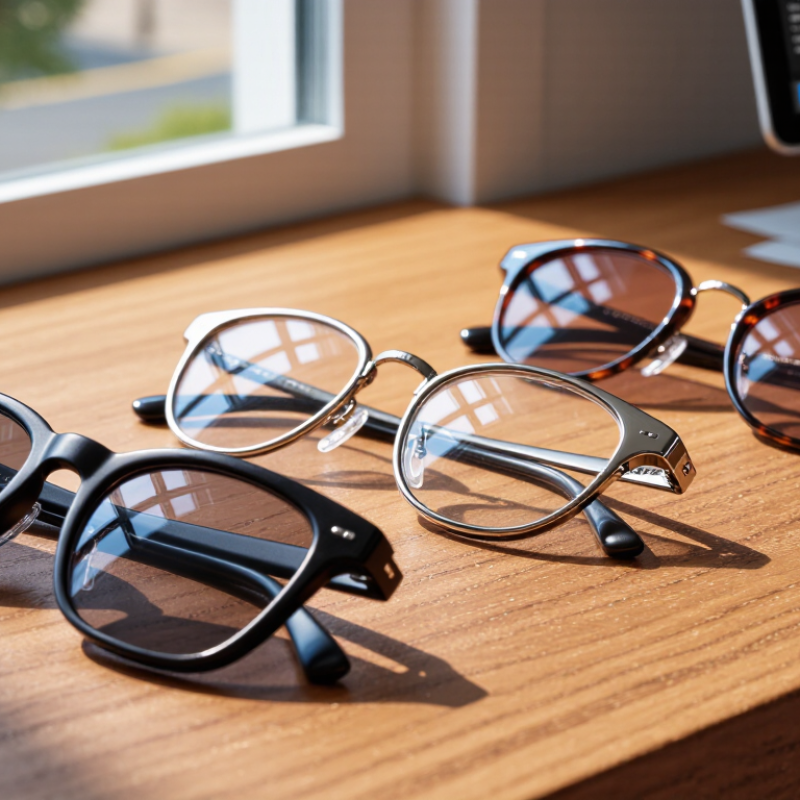
2026 How to Choose Eyeglass Transition Lenses?

How Photochromic Eyeglass Lenses Work

Photochromic eyeglass lenses change tint when exposed to ultraviolet light. Light-sensitive molecules in the lens shift structure and absorb more visible light, making the lenses darker outdoors. When UV exposure falls, they gradually return toward clear. The change is reversible, but not instant. Temperature matters too: many lenses darken more in cool weather and less in heat. Behind a car windshield, UV-triggered lenses may stay lighter because the glass blocks much of the activating UV. Some designs respond to visible light as well, so performance varies.

That difference matters during a real commute. The World Health Organization’s 2019 World Report on Vision estimates that at least 2.2 billion people have near or distance vision impairment, with at least 1 billion cases preventable or unaddressed. This is a global vision-health figure, not proof that photochromic lenses prevent impairment.

When choosing, check the lens’s stated UV protection separately from its tint response, and ask how quickly it clears indoors. One detail is easy to miss: a lens that feels dark outside may not darken equally behind every window. Personal testing helps, though it can be inconvenient.
Assess Your Vision Needs and Daily Light Exposure

Think about where your eyes spend the day. A commute through bright morning sun differs from working beside a shaded window. Note how often you move between indoor lighting, open streets, and reflective surfaces such as snow or water. Be specific.

Your prescription and daily tasks matter, too. If you read small print, use screens for long periods, or need clear vision while driving, discuss those needs with an eye-care professional. Transition lenses change tint with light, but they may not darken much inside some vehicles because windshields block much of the ultraviolet light that activates many lenses. Check how a lens performs in your usual driving conditions; expectations can be off.

Also consider how quickly you need the tint to change. Temperature and lens design can affect how fast lenses darken or return to clear, so ask about performance in your local climate. If you spend hours outdoors, ask whether the lenses provide suitable ultraviolet protection and whether separate sunglasses would be more practical. One detail is easy to miss: people often choose by appearance, then discover the tint does not suit their routine. List your typical light conditions before comparing options, and bring that list to your fitting appointment.

Compare Lens Types, Tint Options, and Activation Speed

2026 How to Choose Eyeglass Transition Lenses?

Photochromic lenses darken outdoors and clear indoors; fixed-tint lenses keep the same shade, while polarized options reduce reflected glare from roads and water. The right choice depends on where you spend your day. For office-to-street routines, a lighter indoor appearance may matter more than maximum darkness. For long drives, check carefully: many photochromic lenses activate less behind windshields because glass filters some ultraviolet light. Not instant.

Tint labels can be misleading. ISO 12312-1:2022 groups sunglass filters by visible-light transmission: Category 2 transmits 18–43%, while Category 3 transmits 8–18%. These figures help compare darkness, but do not tell you how quickly a lens changes. Laboratory and field testing show activation and fading vary with temperature, sunlight, lens material, and coating; darker results can take tens of seconds, while clearing may take several minutes. Cold weather can also make lenses darken more deeply and fade more slowly. I would test a sample outdoors and indoors if possible—my own first choice would not necessarily suit a bright winter commute. Ask an optician for measured transmission and change-time data for the exact lens, rather than relying on tint names alone.

Match Lens Material and Design to Your Prescription

2026 How to Choose Eyeglass Transition Lenses?

Match Lens Material and Design to Your Prescription

A good photochromic lens should suit your prescription, not just darken outdoors. The Vision Council’s 2024 Consumer inSights report found that about 76% of U.S. adults use some form of vision correction. That range of needs matters: a strong prescription can change lens thickness, weight, and edge appearance. Standard plastic often works well for lower prescriptions. Polycarbonate or Trivex can offer lighter, impact-resistant options, while high-index materials may reduce thickness for stronger prescriptions. The best choice depends on your prescription and frame.

Lens design matters, too. Aspheric designs can help reduce edge magnification in some prescriptions, while a well-fitted frame can limit lens thickness and improve comfort. Photochromic performance can vary behind a car windshield, so check the product’s technical specifications if you drive often. A detail is easy to miss: a thin lens may still feel uncomfortable if the frame sits poorly. Ask your optician to compare material, thickness, weight, and fitting measurements.

Tips: Bring your current prescription and name the situations where you wear the glasses. Ask for an edge-thickness estimate in your chosen frame. For high prescriptions, compare lens designs before ordering. Small differences matter. I would not choose by index alone; comfort can be less predictable than the numbers suggest.

2026 How to Choose Eyeglass Transition Lenses? - Match Lens Material and Design to Your Prescription
Prescription or Use Lens Material to Consider Lens Design Photochromic Lens Considerations Practical Selection Tip
Low to moderate prescription; everyday wear Standard plastic (CR-39, index about 1.50) can provide good optical clarity, but may be thicker than higher-index choices at stronger prescriptions. Single vision for one viewing distance; progressive or bifocal designs if near and distance correction are both prescribed. Photochromic options are available in different materials. Darkening and clearing speed depend on the lens formulation, temperature, light, and other conditions. Compare finished lens thickness and weight using your prescription and frame measurements, rather than choosing by index alone.
Moderate to stronger prescription where thickness matters High-index plastic, commonly around 1.60, 1.67, or 1.74, can make lenses thinner than lower-index materials for many prescriptions. Optical performance varies by material. Use the prescribed design and select a frame that suits the prescription. Smaller, well-centered frames can help reduce edge or center thickness. Check that the selected photochromic option is offered in the required index and prescription range; availability is not identical across materials or designs. Ask an optician to compare thickness estimates for the actual frame. An appropriate anti-reflective coating can help manage reflections, particularly with higher-index lenses.
Children, active use, or situations where impact resistance is important Polycarbonate (index about 1.59) and Trivex (index about 1.53) are lightweight, impact-resistant options commonly considered for these uses. Follow applicable safety requirements. Choose single-vision or multifocal design according to the prescription and wearer’s needs; fit and lens retention matter for active use. Confirm compatibility and the intended use with the eye-care professional. Photochromic lenses do not replace protective eyewear where certified safety protection is required. Polycarbonate and Trivex differ in optical properties and availability. The best choice depends on prescription, fit, activity, and professional advice.
High astigmatism or a prescription with substantial cylinder correction Material choice should be based on the full prescription, including sphere, cylinder, axis, and frame size. Higher index may reduce thickness, but does not by itself improve vision. Accurate measurements and lens positioning are especially important. Progressive designs also require precise fitting measurements. Photochromic performance does not correct prescription-related distortion. Confirm that the lens design and material are suitable for the exact prescription. Have the prescription and frame fit checked by a qualified eye-care professional before ordering.
Prescription for both near and distance vision Material can be selected independently of whether the lens is single vision, bifocal, or progressive, subject to product availability and prescription limits. Progressive lenses provide a gradual change in power; bifocals have distinct viewing zones. Adaptation and fitting needs vary by wearer. Photochromic treatment can be combined with some multifocal designs. Confirm the exact combination and allow time to adapt to the lens design if advised. Choose the design based on daily tasks and discuss expected adaptation, fitting measurements, and any prior experience with multifocal lenses.
Frequent driving, including bright conditions Choose a material that meets the prescription, frame, and safety needs; material alone does not determine how dark the lens becomes. Use the distance or multifocal design prescribed for driving. Keep a separate prescription sun lens if additional glare control is needed. Many photochromic lenses darken less behind a standard car windshield because the windshield blocks much of the ultraviolet light that activates them. In-car performance varies by lens technology. Test or verify the intended in-car use before relying on photochromic lenses as the only sun protection for driving.
Outdoor use with changing light CR-39, polycarbonate, Trivex, and high-index plastics may all have photochromic options, depending on the prescription and available lens range. Select single vision or multifocal design according to visual needs; consider a dedicated prescription sun pair for prolonged bright outdoor use. Photochromic lenses typically darken outdoors and become clearer indoors, but may not become completely clear. Cold conditions can affect activation and clearing behavior. Check the lens maker’s current specifications for UV protection, expected color, temperature behavior, and activation behind vehicle glass.
Reducing reflections or improving surface durability Coatings can be used with many lens materials, but coating availability and recommended combinations vary. Coatings do not change the prescribed lens design or replace accurate measurements. Ask whether anti-reflective, scratch-resistant, or water- and smudge-resistant treatments are compatible with the chosen photochromic lens. Coatings have different purposes: scratch-resistant treatments help reduce everyday scratching, while anti-reflective treatments reduce reflections. No coating makes a lens scratch-proof.

Selection note: Lens index, material, photochromic response, and design availability vary by prescription and product. A qualified eye-care professional can verify the prescription, fitting measurements, material suitability, and intended use. Photochromic lenses are not a substitute for prescription sunglasses or certified protective eyewear when those are needed.

Check UV Protection, Indoor Clarity, and Frame Compatibility

2026 How to Choose Eyeglass Transition Lenses?

Check the UV rating, not just how dark the lenses become. Look for clear documentation of UVA and UVB protection, such as a UV400 specification. Photochromic tint and UV protection are related, but darkness alone does not prove coverage. Ask an optician to verify the lens details, especially if the packaging is unclear. A small check matters.

Indoor clarity deserves a real-world test. Stand near a window, then move beneath ordinary office lighting and notice any residual tint. Most lenses are designed to clear indoors, but clearing speed and appearance vary by lens type, temperature, and age. In a warm room, lenses may react less strongly outdoors; cold weather can make them darken more. Car windshields also block much of the UV that activates many standard photochromic lenses, so driving performance may be limited. I would not judge them from one quick shop visit.

Check frame compatibility before ordering. Lens shape, size, prescription strength, and frame construction can affect thickness and how well the lenses fit. Bring your actual frame to the optician rather than relying only on a photo. A very large lens may feel heavier, while a narrow frame can limit your view through the tinted area. Ask how the lenses behave with your prescription. Small details count. A fitting can still involve trade-offs, and I sometimes find that the darkest outdoor tint is not the most comfortable choice indoors.